
The standard
NFPA 96: how often, and what you should be left with
Your fire inspector cites NFPA 96. It sets an inspection schedule rather than a cleaning calendar, and it asks for three records at the end of a clean. Here is what each one is, and how to check you got it.
01How often
The standard does not set a cleaning calendar
It sets how often the system has to be looked at. What the inspection finds is what decides whether it gets cleaned.
| Inspect | Cooking volume |
|---|---|
| Monthly | Solid fuelWood or charcoal, whatever else is on the line |
| Quarterly | High volumeCharbroiling, wok cooking, a line running around the clock |
| Semiannually | Moderate volumeMost restaurants sit here |
| Annually | Low volumeSeasonal kitchens, church halls, day camps, senior centres |
Those are the rows of Table 11.4 in the 2021 edition — the one Florida adopts through Fla. Admin. Code 69A-60.005. The examples under each row are the standard’s own illustrations, not a test you can score yourself against, and there is no covers-per-day threshold anywhere in it.
Cleaning is triggered by what the inspection measures. The line is a grease depth of 0.078 in. (2,000 µm) on the surfaces of the system, and 0.125 in. (3,175 µm) inside a fan housing. Past that, it comes off.
Which row a kitchen sits in is a judgement about that kitchen, and not one to make from a web page. The way to find out is to open an access panel and look — tell us what you cook and we’ll take it from there.
What a clean should leave behind
Three records, and the standard asks for all three. They are also the simplest way to check any contractor’s work, ours included — handed none of them, you have no record that the job happened.
A label on the hood
A sticker on the equipment itself, carrying who cleaned it, the date, and any areas that were not cleaned. It is the first thing an inspector looks for, because it is the only one of the three that lives on the hood.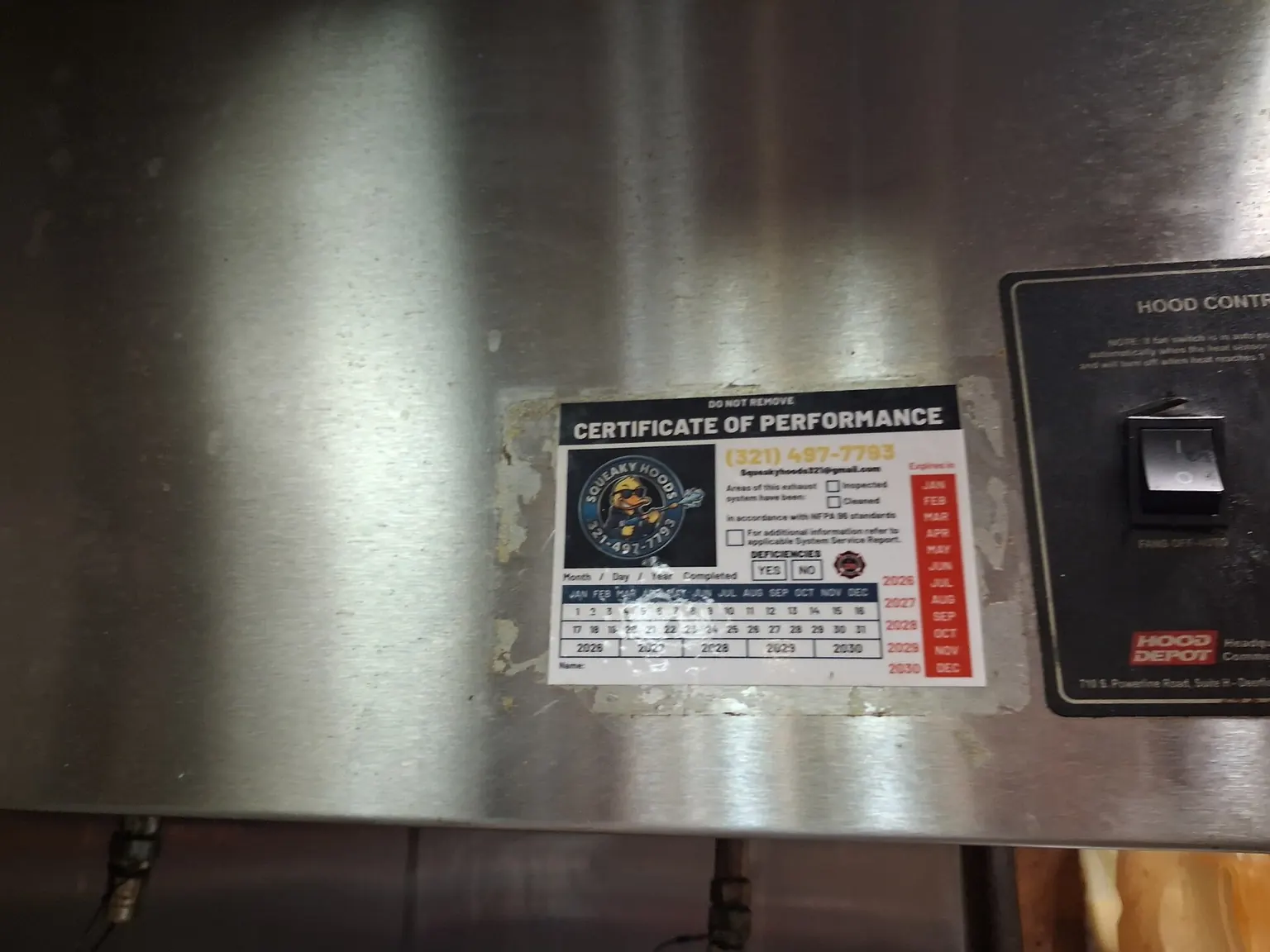
A certificate for your records
The servicing company, the person who actually did the work, and the date — issued to you and kept on the premises. Ours is headed Certificate of Performance.A written note of what could not be reached
Where a run of duct has no access panel, the standard asks for that in writing rather than left unmentioned. It is the record most kitchens have never been handed, and the one that tells you what is still up there.
Start with a look inside
Find out what your system actually needs
Tell us what you run and how hard it runs. We’ll come back with a quote that says how far up the system the clean goes.